
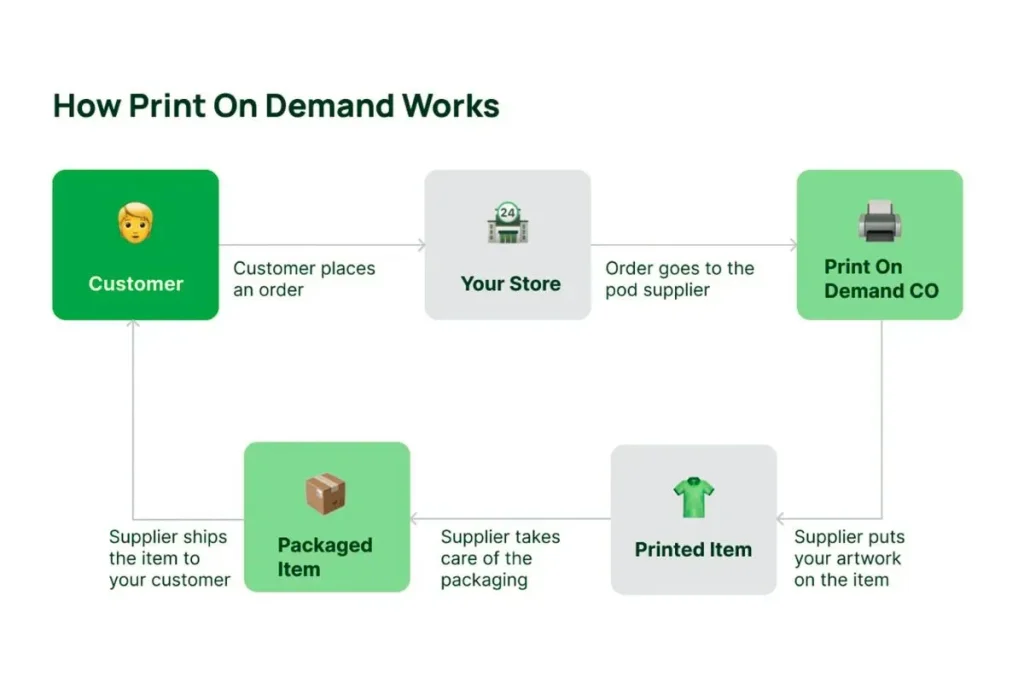
print on demand makes it possible to turn ideas into tangible products without upfront inventory. In a POD workflow, items like t-shirts, mugs, and wall art are produced only after a customer places an order, minimizing risk. This approach enables you to test designs and refine messaging while growing a brand with modest capital within a POD business model. If you’re considering launching a brand, this guide shows how to start a POD brand, how to select the best print on demand platforms, and how to implement print on demand marketing. Focusing on niche, branding, and customer experience helps build a scalable online store.
A no-inventory, on-demand manufacturing approach lets creators turn digital artwork into physical products only when customers buy. This model relies on specialized print partners and fulfillment networks that handle printing and shipping, enabling focus on branding and customer experience. By framing your offer around unique storytelling, quality production, and rapid experimentation, you can build a merch line that resonates without heavy upfront risk. Think of it as a flexible e-commerce production system where designs travel from digital file to doorstep through integrated platforms. Used wisely, this approach scales with demand and supports ongoing testing of new ideas and products.
How to Start a Print on Demand Brand: Define Your Niche and Audience
Starting a print on demand brand begins with pinpointing a precise niche and a clearly defined audience. Identify who your designs will resonate with, the problems they’re looking to solve, and the lifestyle your products will embody. This clarity underpins every decision in the POD business model, helping you tailor designs, messaging, and product choices so you can test concepts with real buyers rather than guessing.
To validate your direction, conduct lightweight market research using keyword analysis and social listening to gauge demand. Test a few designs in low-friction ways—short social campaigns, landing pages, or minimal listings—to capture interest and initial signals. When your niche and audience basis align with real demand, you set a strong foundation for a scalable POD brand and a practical path on how to start a POD brand successfully.
Validating Ideas and Selecting Products for POD Success
Validation and product selection go hand in hand. Start by listing potential products—tees, hoodies, mugs, phone cases, tote bags, and wall art—and create design concepts for each. Use low-friction tests such as organic posts, simple product pages, or micro-ad campaigns to observe engagement, click-throughs, and early purchases, collecting signals that reveal demand and fit.
Not every niche suits every product. Consider audience preferences, perceived value, and production constraints like colorways and print methods. Use insights from validation to narrow your catalog, focusing on the most promising combinations that align with your niche and brand story within the POD business model.
Choosing and Comparing the Best Print on Demand Platforms for Your Store
When selecting where to sell, evaluate the best print on demand platforms by looking at production quality, print capabilities, catalog breadth, base costs, and how smoothly the platform integrates with your chosen storefront (Shopify, WooCommerce, Etsy, Squarespace). Reliable fulfillment, accurate color reproduction, and responsive support are essential to consistently satisfy customers.
A practical approach is to pilot a small line on one platform first—often starting with apparel on a trusted provider—and monitor performance before expanding. A multi-platform strategy can optimize margins across product types, but begin with a solid core on a single platform to validate your designs and process before broadening your POD footprint.
Brand Identity, Storytelling, and Design that Distinguish Your POD Brand
Brand identity is the bridge between your designs and customer perception. Craft a memorable brand name, a logo that reflects your niche, and a cohesive color palette and typography that carry across your store, packaging, and marketing. A compelling brand story explains why your brand exists and what it stands for, creating emotional alignment with your target audience.
Product storytelling goes beyond visuals. Share the inspiration behind designs, the materials and print methods used, and any sustainability or ethical commitments. High-quality photography and lifestyle mockups help customers imagine themselves using your products, while behind-the-scenes content deepens engagement and builds long-term trust in your POD brand.
Pricing, Margins, and Profitability within the POD Business Model
Profitability hinges on carefully calculating base costs, fulfillment fees, shipping, and platform charges. Establish a target profit per item and work backward to set prices that cover costs while staying attractive to customers. Track core metrics such as margin, contribution per unit, and overall profitability to guide future decisions.
Consider tiered pricing, limited editions, bundles, or add-ons to lift average order value without dramatically increasing production costs. Regularly test pricing positions and monitor how changes affect demand within your POD business model, ensuring sustainable margins as your catalog grows.
Marketing, Traffic, and Growth: Print on Demand Marketing Essentials
Growing a POD brand requires a balanced mix of organic and paid channels, content marketing, and community building. Implement a content plan, optimize product pages for search with targeted keywords, and engage audiences across social platforms. Email marketing, influencer collaborations, and user-generated content can drive sustainable growth and repeat purchases within a print on demand strategy.
Data-driven optimization is critical. Monitor metrics such as click-through rate (CTR), conversion rate, cost per acquisition (CPA), and customer lifetime value (CLV). Use these insights to refine designs, marketing messages, and product mixes, maintaining brand consistency and delivering a superior customer experience that fuels ongoing growth.
Frequently Asked Questions
What is print on demand and how does it work for a new POD brand?
Print on demand (POD) is a fulfillment model where products are printed only after a customer places an order, so you don’t hold inventory or risk large upfront costs. For a new POD brand, this model lets you test designs, iterate quickly, and scale with relatively little capital. A typical flow includes defining your niche, choosing a POD platform, creating scalable designs, setting pricing for profitability, and launching with targeted marketing. By focusing on quality branding and a great customer experience, you can build a sustainable POD brand without a warehouse.
What are the first steps to start a POD brand and how to start a POD brand?
To start a POD brand, begin with niche definition and audience research. Validate ideas using small tests (organic posts, simple landing pages, or micro ads) and mockups for multiple products. Then shortlist products that fit your concept, choose a platform, set up your storefront, and develop a cohesive brand and product storytelling. Finally, launch with a minimal first line and iterate based on feedback. This approach aligns with the key steps to start a POD brand and minimizes risk as you learn.
What are the best print on demand platforms for beginners and why?
Best print on demand platforms balance production quality, price, and ease of use. Look for reliable print capabilities, a broad product catalog, reasonable base costs, and strong storefront integrations (Shopify, WooCommerce, Etsy). Helpful features include sample orders, color accuracy, and good support. Popular options for beginners include Printful, Printify, Gooten, and Teelaunch. Test with samples to verify print quality before listing products.
What is the POD business model and what are its key advantages for new creators?
The POD business model centers on production-on-demand triggered by orders, meaning you sell without bulk inventory. Key advantages include low upfront costs, scalable product options, and flexibility to adjust designs quickly. Potential tradeoffs include shipping timelines and reliance on platform print quality. With clear niche targeting, strong branding, and reliable fulfillment, creators can build a sustainable POD business model.
How can I design an effective print on demand marketing plan to grow my store?
An effective print on demand marketing plan combines organic and paid channels with strong content and SEO. Focus on niche-relevant content, on-page optimization, social proof, and email marketing. Use influencer collaborations and UGC to amplify reach, and run targeted ads with clear creative variants. Track metrics like CTR, conversion rate, CPA, and CLV to refine messaging, products, and offers. Consistency in branding and product storytelling is key to successful print on demand marketing.
What pricing strategies work in a print on demand business model to protect margins?
In a print on demand business model, start by calculating the base cost per product (printing, fulfillment, handling) plus fees, then set a price that achieves a healthy margin. Consider tiered pricing, bundles, and limited editions to increase order value, and experiment with pricing based on demand and seasonality. Regularly review margins and adjust with clear rationale to maintain profitability while staying competitive in the print on demand marketplace.
| Section | Key Points |
|---|---|
| Introduction |
|
| Step 1: Define your niche and audience |
|
| Step 2: Validate ideas and product selection |
|
| Step 3: Choose and compare POD platforms |
|
| Step 4: Build your brand identity and product storytelling |
|
| Step 5: Create designs that resonate and scale your catalog |
|
| Step 6: Pricing, margins, and profitability |
|
| Step 7: Storefront setup and product listing optimization |
|
| Step 8: Marketing, traffic, and audience growth |
|
| Step 9: Fulfillment, customer service, and returns |
|
| Step 10: Analytics, learning, and scaling |
|
| Conclusion (from base content) |
|
Summary
Print on demand is a scalable, low-risk path for creators to turn ideas into physical products without upfront inventory. By defining a niche, validating ideas, selecting the right POD platforms, building a cohesive brand, designing products that resonate, pricing strategically, optimizing storefronts, and executing data-driven marketing and exceptional customer service, you can build a sustainable, scalable print on demand business. This approach emphasizes quality, branding, and customer experience to foster loyalty and repeat purchases in a competitive ecommerce landscape.